Introduction
Shapes are one of the most fundamental elements in the world of art and design. Every visual creation you see—whether it is a painting, sculpture, logo, poster, or digital illustration—is built using shapes. Without shapes, art cannot exist because they form the basic structure of all visual compositions. Understanding shape in art is very important for beginners as well as professional artists. Shapes help in building composition, expressing emotions, guiding the viewer’s eye, and creating balance in artwork. Even the most complex artworks start with simple shapes like circles, squares, and triangles. In this detailed guide, we will explore what shapes in art mean, their types, importance, real-world examples, and how artists use them in creative work.
What is Shape in Art?
In art, a shape is a two-dimensional area that is defined by lines, edges, or changes in color or texture. Shapes are flat and do not have depth, but they can create the illusion of depth when used with shading and perspective.
Shapes are everywhere in visual life:
- Nature (leaves, clouds, rocks)
- Architecture (buildings, windows, doors)
- Design (logos, posters, websites)
- Fine art (paintings and drawings)
Artists use shapes as the building blocks of design. Before drawing a complete object, they often break it down into simple shapes to understand structure and proportion.
Importance of Shapes in Art
Shapes are not just visual elements—they are powerful tools for communication and design. Here are the key reasons why shapes are important:
1. Foundation of All Artworks
Every drawing begins with basic shapes. A human face starts with a circle, a house starts with a square or rectangle, and animals can be simplified into oval and triangle forms.
2. Creates Structure and Organization
Shapes help artists organize space in a composition. They make artwork look clean, structured, and balanced.
3. Expresses Emotions and Ideas
Different shapes create different emotional responses:
- Circles → peace, unity, softness
- Squares → stability, strength, order
- Triangles → power, tension, movement
4. Improves Visual Balance
Proper use of shapes prevents artwork from looking empty or too crowded. They distribute visual weight evenly.
5. Helps in Storytelling
Shapes can guide the viewer’s attention and tell a visual story without words.
Types of Shapes in Art
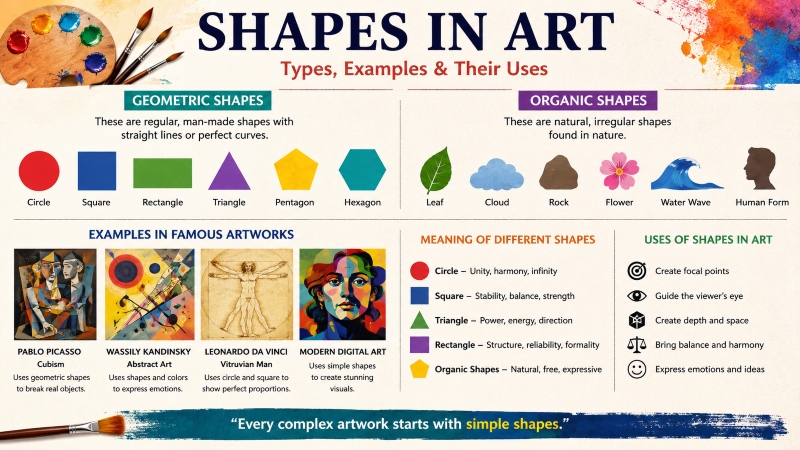
Shapes in art are mainly divided into two categories: Geometric shapes and Organic shapes.
1. Geometric Shapes
Geometric shapes are precise, regular, and mathematical. They are usually created using tools like rulers or digital software.
Examples of Geometric Shapes:
- Circle
- Square
- Rectangle
- Triangle
- Pentagon
- Hexagon
Characteristics:
- Clean and structured
- Measurable and symmetrical
- Common in man-made designs
Where they are used:
- Architecture (buildings, bridges)
- Logo design (brands like Apple, Nike concepts)
- Graphic design
- Modern abstract art
Geometric shapes often give a feeling of order, logic, and stability.
2. Organic Shapes
Organic shapes are natural, irregular, and free-flowing. They are not perfectly measured and are inspired by nature.
Examples of Organic Shapes:
- Leaves
- Clouds
- Human body
- Flowers
- Stones
- Water waves
Characteristics:
- Irregular and unpredictable
- Soft and flowing edges
- Inspired by nature
Where they are used:
- Nature paintings
- Portraits
- Abstract art
- Illustration and sketching
Organic shapes often create feelings of freedom, creativity, and emotion.
Shapes in Art and Their Meaning
| Shape Type | Example Shape | Visual Meaning | Emotional Effect | Common Usage |
|---|---|---|---|---|
| Geometric | Circle | Unity, infinity | Calm, harmony | Logos, mandalas, design |
| Geometric | Square | Stability, order | Strength, balance | Architecture, layouts |
| Geometric | Triangle | Direction, energy | Power, tension | Posters, abstract art |
| Geometric | Rectangle | Structure, reliability | Formal, steady | Buildings, frames |
| Organic | Leaf | Growth, nature | Freshness, life | Botanical art, patterns |
| Organic | Cloud | Softness, freedom | Calm, dreamy | Landscapes |
| Organic | Human form | Emotion, realism | Connection | Portraits, sculpture |
| Organic | Water waves | Flow, movement | Energy, change | Abstract designs |
How Artists Use Shapes in Composition
Artists carefully arrange shapes to create strong visual compositions.
1. Creating Focal Point
A large or contrasting shape is used to draw attention to the main subject.
2. Guiding Eye Movement
Shapes direct the viewer’s eyes through the artwork in a specific path.
3. Creating Depth
Overlapping shapes create the illusion of distance and space.
4. Building Emotion
Sharp shapes create tension, while soft shapes create calmness.
5. Pattern and Rhythm
Repeating shapes create rhythm and visual interest in artwork.
Shapes in Modern Design
Shapes are not limited to traditional art. They are widely used in modern design fields.
1. Logo Design
Brands use simple geometric shapes to create strong and memorable identities.
2. Web and App Design
Shapes help structure layouts and improve user experience.
3. Advertising
Posters and ads use bold shapes to grab attention quickly.
4. Product Design
Shapes influence the design of objects like furniture, cars, and packaging.
Difference Between Shape and Form
Many beginners confuse shape and form, but they are different:
- Shape: Two-dimensional (flat)
- Form: Three-dimensional (has depth)
Example:
- A circle is a shape
- A sphere is a form
Understanding this difference helps artists create more realistic drawings.
Why Artists Must Learn Shapes
Learning shapes is essential for every artist because it helps to:
- Improve drawing accuracy
- Build strong compositions
- Understand proportions
- Develop creativity
- Create professional-level designs
Even advanced artists start every artwork using basic shapes before adding details.
Conclusion
Shapes are the foundation of all visual art and design. They help artists create structure, meaning, and emotion in their work. Whether geometric or organic, each shape has its own purpose and effect. From ancient paintings to modern digital graphics, shapes continue to play a key role in visual communication. By understanding and practicing shapes, any artist can improve their skills and create more powerful and meaningful artwork. Mastering shapes is not just a basic step—it is the first and most important step in becoming a successful artist or designer.