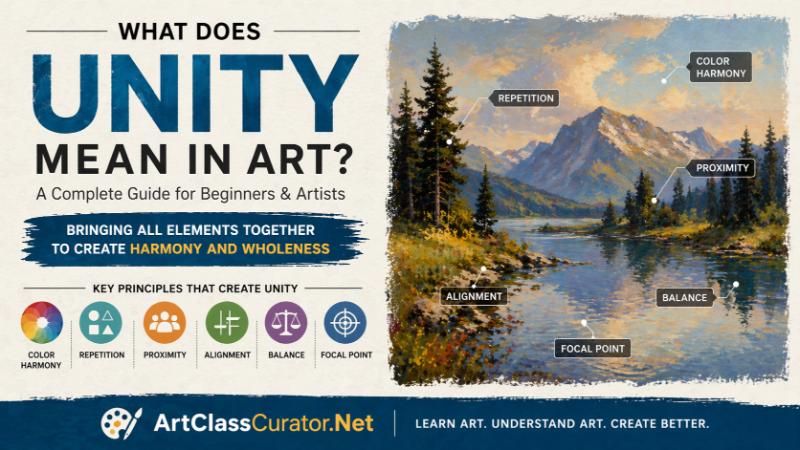
Introduction: Why Unity Matters More Than You Think
If you’ve ever looked at a painting, design, or sculpture and felt that everything just “fits,” you’ve experienced unity in art—even if you didn’t know the term. So, what does unity mean in art? In simple words, unity is the principle that makes all elements of an artwork feel connected, balanced, and complete. Without it, even technically skilled art can look confusing or unfinished. As someone deeply familiar with art principles, I can tell you this: beginners often focus on color or technique first—but professionals prioritize unity because it ties everything together. In this guide, you’ll learn not only the definition but also real examples, techniques, mistakes to avoid, and practical ways to apply unity in your own work.
What Does Unity Mean in Art?
Unity in art refers to the visual harmony created when all elements—color, shape, texture, and composition—work together cohesively.
Key Definition:
Unity = A sense of completeness where all parts of an artwork belong together.
Why It Matters:
- It makes artwork visually pleasing
- It improves clarity and message
- It guides the viewer’s eye smoothly
Without unity, even beautiful elements can feel disconnected.
Core Elements That Create Unity in Art
To fully understand what does unity mean in art, you need to see how it’s built.
Color Harmony
Using a consistent color palette creates a strong connection.
- Analogous colors → smooth and calm feel
- Monochromatic schemes → strong unity
Pro Tip: Limit your palette to 3–5 main colors for better cohesion.
Repetition of Elements
Repeating shapes, lines, or patterns helps unify a design.
Examples:
- Repeated geometric shapes
- Consistent brush strokes
- Patterns in textile art
Repetition builds familiarity, which naturally creates unity.
Proximity (Grouping)
Objects placed close together appear related.
- Grouping elements = stronger visual relationship
- Scattered elements = confusion
Designers use this heavily in layouts and UI design.
Alignment
Proper alignment ensures structure.
- Center alignment → formal unity
- Grid systems → professional layouts
Misalignment can instantly break unity.
Balance
Balance supports unity by distributing visual weight.
Types:
- Symmetrical balance
- Asymmetrical balance
- Radial balance
When balance is off, unity feels unstable.
Unity vs Harmony: What’s the Difference?
Many people confuse these two concepts.
| Aspect | Unity | Harmony |
|---|---|---|
| Meaning | Overall togetherness | Compatibility of elements |
| Focus | Whole artwork | Individual relationships |
| Role | Final effect | Supporting factor |
Types of Unity in Art
Understanding types helps you apply unity effectively.
Conceptual Unity
All elements support a central idea or theme.
Example:
A war painting where every detail reflects conflict.
Visual Unity
Unity created through visual elements like color and shape.
Example:
Minimalist art with consistent tones and forms.
Compositional Unity
Unity achieved through layout and arrangement.
Example:
Photography using rule of thirds and alignment.
Real-Life Examples of Unity in Art
Example: Minimalist Design
- Limited colors
- Clean shapes
- Consistent spacing
Result: Strong visual unity
Example: Renaissance Paintings
Artists used:
- Balanced composition
- Controlled lighting
- Repeated forms
Result: Natural harmony and unity
Example: Modern UI Design
Apps use:
- Consistent fonts
- Repeated icons
- Grid layouts
Result: Seamless user experience
How to Create Unity in Your Artwork (Step-by-Step)
If you’re an artist or designer, follow this proven process:
Choose a Clear Theme
Ask yourself:
- What message do I want to convey?
Limit Your Elements
Avoid overcomplicating:
- Too many colors
- Too many styles
Less = more unity
Use Repetition Intentionally
Repeat:
- Colors
- Shapes
- Textures
Maintain Consistency
Keep:
- Lighting style
- Perspective
- Scale
Review and Refine
Zoom out and ask:
- Does everything feel connected?
If not, simplify.
Common Mistakes That Break Unity
Even experienced artists struggle with this.
❌ Too Many Colors
Creates chaos instead of harmony
❌Inconsistent Style
Mixing realism with abstract randomly
❌Poor Composition
Unbalanced layouts disrupt flow
❌Overcrowding
Too many elements reduce clarity
Unity in Different Art Forms
Painting
Unity comes from:
- Brush style
- Color palette
- Lighting
Graphic Design
Unity is achieved through:
- Typography consistency
- Layout grids
- Branding elements
Photography
Unity depends on:
- Composition
- Lighting
- Subject focus
Sculpture
Unity involves:
- Material consistency
- Form and proportion
Why Unity Is Essential in Art
Understanding what does unity mean in art is not just theory—it directly impacts quality.
Key Benefits:
- Improves visual clarity
- Enhances emotional impact
- Creates professional-level work
- Keeps viewers engaged longer
Expert Insight: A Practical Perspective
From real-world experience, unity is not about making everything identical—it’s about making everything belong. Many beginners try to add more details to improve their work. However, professionals often do the opposite: they remove unnecessary elements to strengthen unity.
👉 Golden Rule:
If something doesn’t support the main idea, remove it.
Quick Checklist for Unity in Art
Before finishing your artwork, ask:
- Are my colors consistent?
- Do elements feel connected?
- Is there a clear focal point?
- Does anything feel out of place?
If all answers are “yes,” your artwork likely has strong unity.
Conclusion
So, what does unity mean in art? It is the invisible force that transforms separate elements into a cohesive masterpiece. Whether you are a beginner or an experienced artist, mastering unity will instantly elevate your work. It’s not about adding more—it’s about connecting what already exists. Start applying these principles today, and you’ll notice your artwork becoming more professional, balanced, and impactful. Visit my site for further detail.
FAQs (For Rich Snippets)
1. What does unity mean in art in simple terms?
Unity in art means all parts of an artwork work together to create a complete and balanced look.
2. Why is unity important in art?
It makes artwork visually pleasing, organized, and easier to understand.
3. How is unity created in art?
Through repetition, color harmony, balance, alignment, and consistent style.
4. Is unity the same as harmony?
No. Harmony refers to compatibility, while unity is the overall sense of completeness.
5. Can an artwork have too much unity?
Yes. Too much unity can make art look boring or lack contrast.
6. What is an example of unity in art?
A minimalist painting with limited colors and repeated shapes is a strong example.