Introduction
Art is not only about colors, shapes, and lines—it is also about how elements are arranged within a composition. One of the most important yet often overlooked principles is space. The space element of art refers to the area around, between, and within objects in an artwork. Understanding space helps artists create depth, perspective, and balance. Whether you are a beginner or a professional artist, learning how to use space effectively can elevate your artwork to a whole new level. In this guide, we will explore the concept of space, its types, real-life examples, and how artists use it creatively.
What Is Space in Art?
Space in art refers to the area that surrounds or exists between visual elements. It can be positive (occupied) or negative (empty). Artists manipulate space to create illusions of depth, distance, and dimension.
In simple terms:
- Space shows where objects exist
- It helps define relationships between elements
- It creates a sense of depth or flatness
Types of Space in Art
Understanding the types of space is essential for mastering this element:
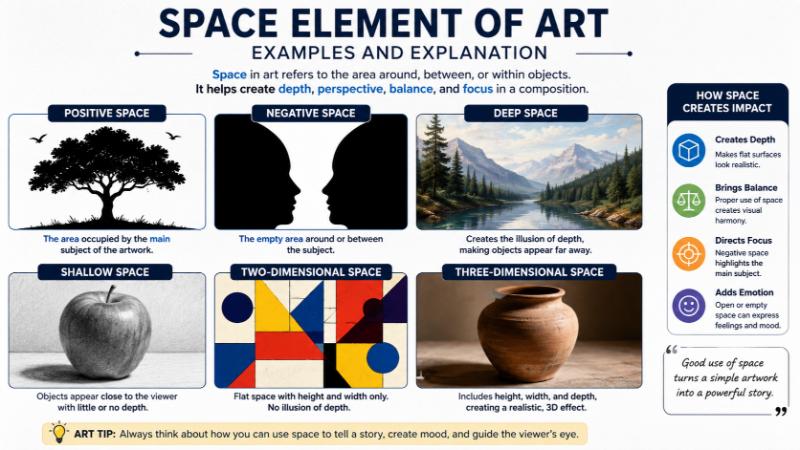
1. Positive Space
Positive space is the area occupied by the main subject of the artwork.
Example: A tree in a landscape painting.
2. Negative Space
Negative space is the empty area surrounding the subject.
Example: The sky around the tree.
3. Deep Space
This creates the illusion of depth, making objects appear far away.
Example: A road disappearing into the horizon.
4. Shallow Space
In shallow space, objects appear close to the viewer with little depth.
Example: Portrait paintings.
5. Two-Dimensional Space
Flat space with height and width only.
6. Three-Dimensional Space
Includes depth, making objects look realistic.
Types of Space in Art with Examples
| Type of Space | Definition | Example |
|---|---|---|
| Positive Space | Area occupied by subject | A person in a portrait |
| Negative Space | Empty surrounding area | Background sky |
| Deep Space | Illusion of depth | Landscape with mountains |
| Shallow Space | Minimal depth | Close-up face painting |
| 2D Space | Flat surface | Abstract art |
| 3D Space | Realistic depth | Sculpture |
Elements That Create Space in Art
Artists use several techniques to create the illusion of space:
1. Perspective
Perspective is one of the most powerful tools for creating depth.
- Linear perspective (vanishing points)
- Atmospheric perspective (fading colors)
2. Overlapping
When one object overlaps another, it appears closer.
3. Size Variation
Larger objects appear closer; smaller ones appear farther away.
4. Placement
Objects placed higher on the canvas appear farther away.
5. Color and Value
Lighter and cooler colors appear distant, while darker and warmer tones appear closer.
Space Element of Art Examples
1. Landscape Painting
In landscape art, space is used to create distance between foreground, middle ground, and background.
Example: Mountains fading into the background.
2. Portrait Art
Portraits often use shallow space to focus attention on the subject.
3. Abstract Art
Artists use negative space creatively to form hidden shapes or meanings.
4. Photography
Photographers use space to frame subjects and create visual storytelling.
5. Architecture
Buildings use physical space to create structure and functionality.
Importance of Space in Art
Space plays a critical role in artistic composition:
✔️ Creates Depth
It helps transform flat surfaces into realistic scenes.
✔️ Improves Balance
Proper use of space prevents overcrowding.
✔️ Enhances Focus
Negative space draws attention to the main subject.
✔️ Adds Emotion
Open space can create feelings of loneliness, freedom, or calmness.
How to Use Space Effectively in Art
1. Balance Positive and Negative Space
Avoid overcrowding your composition.
2. Use Perspective Techniques
Create depth with vanishing points.
3. Experiment with Minimalism
Sometimes less space creates more impact.
4. Practice Composition
Arrange elements thoughtfully before finalizing artwork.
Common Mistakes When Using Space
| Mistake | Description |
|---|---|
| Overcrowding | Too many elements in one area |
| Ignoring Background | Weak or empty background |
| Lack of Depth | Flat-looking composition |
| Poor Proportion | Incorrect size relationships |
Space in Modern and Digital Art
In modern design and digital art, space is equally important:
- Website design uses white space for readability
- Graphic design uses spacing for visual hierarchy
- UI/UX design relies on space for user experience
Conclusion
The space element of art is a fundamental concept that shapes how we perceive and interpret visual compositions. From creating depth to enhancing focus, space plays a vital role in both traditional and modern art forms. By understanding and applying space effectively, artists can create more engaging, balanced, and meaningful artworks. Whether you’re drawing, painting, or designing digitally, mastering space will significantly improve your creative skills.
FAQs About Space Element of Art
1. What is space in art?
Space in art refers to the area around, between, and within objects in a composition.
2. What is positive and negative space?
Positive space is the subject, while negative space is the empty area around it.
3. Why is space important in art?
It helps create depth, balance, and focus in artwork.
4. What are examples of space in art?
Landscape paintings, portraits, photography, and abstract art all use space.
5. How can beginners improve space usage?
Practice perspective, balance elements, and study real-life compositions.