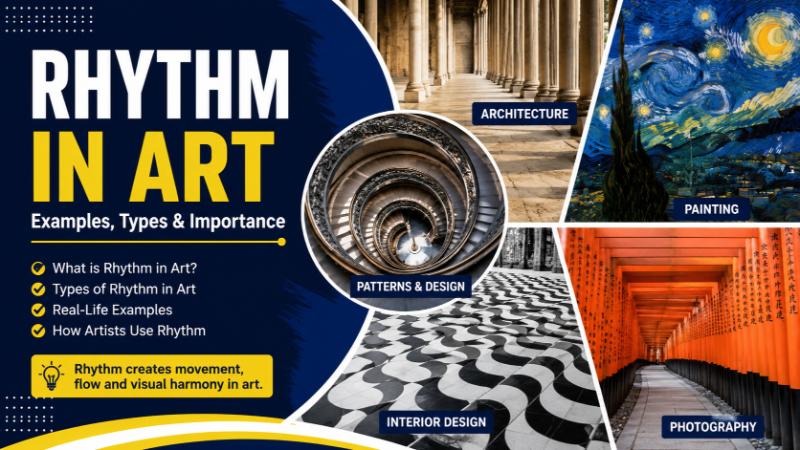
What is Rhythm in Art?
Rhythm in art refers to the repetition or organized movement of visual elements that creates a sense of flow within a composition. These elements may include lines, shapes, colors, textures, or patterns. The goal is to guide the viewer’s eye from one point to another in a smooth and intentional way. Rhythm can be compared to the beat in music. In the same way music uses repeated beats or variations, art uses repeated visual components to create structure and harmony.
For example:
- Repeated arches in architecture create visual rhythm
- Alternating colors in a painting guide the eye
- Repeating patterns in textiles create decorative rhythm
Importance of Rhythm in Art
Rhythm plays a crucial role in making artwork visually appealing and meaningful. Here are some key reasons why rhythm is important:
1. Creates Visual Movement
Rhythm helps the viewer’s eye move across the artwork instead of staying fixed on one point.
2. Builds Unity and Harmony
It connects different elements of art and makes the composition feel complete.
3. Enhances Emotional Impact
Different rhythms can create feelings like calmness, excitement, or tension.
4. Adds Structure
Rhythm organizes visual elements in a planned and balanced way.
5. Improves Aesthetic Appeal
A well-rhythmic artwork looks more professional and engaging.
Types of Rhythm in Art
Understanding different types of rhythm helps in identifying how artists create flow in their work.
1. Regular Rhythm
This involves repeating elements at equal intervals. It is predictable and stable.
2. Alternating Rhythm
Two or more elements are repeated in a pattern, such as ABAB.
3. Progressive Rhythm
Elements change gradually in size, color, or shape.
4. Flowing Rhythm
Curved lines or organic shapes create a natural movement.
5. Random Rhythm
Elements are repeated without a strict order, but still feel unified.
Rhythm in Art Examples
Below is a simple table that explains different types of rhythm with real-life examples:
| Type of Rhythm | Description | Example in Art | Where You See It |
|---|---|---|---|
| Regular Rhythm | Repetition at equal intervals | Rows of identical columns in Greek temples | Architecture |
| Alternating Rhythm | Two or more elements repeated in sequence | Black and white tiles on a floor | Interior design, flooring |
| Progressive Rhythm | Gradual change in elements | Size of circles increasing in a painting | Modern abstract art |
| Flowing Rhythm | Smooth curved movement | Ocean waves in landscape painting | Nature-inspired art |
| Random Rhythm | Irregular but unified repetition | Leaves scattered in a natural composition | Impressionist paintings |
Real-Life Examples of Rhythm in Art
1. Architecture
Buildings often use rhythm in columns, windows, and arches. For example, classical Greek and Roman architecture uses evenly spaced columns that create a strong regular rhythm.
2. Painting
Artists like Claude Monet used flowing rhythm in water lilies and landscapes to guide the viewer’s eye naturally across the canvas.
3. Sculpture
Sculptures often use repeating shapes or forms to create rhythm and balance, especially in large installations.
4. Interior Design
Patterns in wallpapers, tiles, and furniture arrangement create alternating and regular rhythms in rooms.
5. Fashion Design
Clothing patterns such as stripes, polka dots, and repeated embroidery create visual rhythm in fashion.
How Artists Use Rhythm Effectively
Artists carefully plan rhythm to improve composition. They use several techniques:
Repetition
Repeating similar elements like shapes or colors.
Variation
Changing size, color, or spacing slightly to avoid monotony.
Movement Direction
Guiding the viewer’s eye using lines or curves.
Contrast
Using opposite elements to create visual interest.
Rhythm vs Pattern in Art
Many people confuse rhythm with pattern, but they are not exactly the same.
- Pattern is the repetition of elements in a fixed design.
- Rhythm is the flow or movement created by those patterns.
For example, a repeated wallpaper design is a pattern, but the way your eyes move across it creates rhythm.
Psychological Effect of Rhythm in Art
Rhythm can strongly affect human emotions and perception:
- Regular rhythm → calmness and stability
- Flowing rhythm → relaxation and natural feeling
- Progressive rhythm → excitement and curiosity
- Random rhythm → creativity and unpredictability
This is why rhythm is widely used in advertising, branding, and visual storytelling.
Famous Artists Who Used Rhythm
Many famous artists have mastered rhythm in their work:
- Pablo Picasso – used structured rhythm in Cubism
- Vincent van Gogh – used flowing rhythm in brush strokes
- Claude Monet – created soft natural rhythm in landscapes
- Jackson Pollock – used random rhythm in abstract expressionism
Conclusion
Rhythm in art is an essential principle that brings life, movement, and harmony to visual compositions. Whether it is architecture, painting, fashion, or design, rhythm helps organize elements in a way that feels natural and engaging. By understanding different types of rhythm such as regular, alternating, progressive, flowing, and random, artists can create more powerful and expressive works. The examples provided in the table clearly show how rhythm exists everywhere in visual culture. In short, rhythm is what transforms simple elements into a meaningful artistic experience.