Introduction
Great art does not happen by chance. Behind every masterpiece is a hidden structure. Artists use mathematics to create beauty. They use special proportions to guide every line, shape, and space. These proportions have been used for thousands of years. Ancient Greeks used them. Renaissance painters used them. Modern designers still use them today. In this article, you will learn about the most famous proportions in art. You will see how they work. You will also discover where they appear in the world’s greatest artworks.
What Is Proportion in Art?
Proportion means the size relationship between parts of a composition. When parts relate to each other in a pleasing way, the art feels balanced. It feels right. Some proportions follow simple rules. Others follow complex mathematics. But all of them serve one goal — to create beauty that the eye can trust.
1. The Golden Ratio
What Is It?
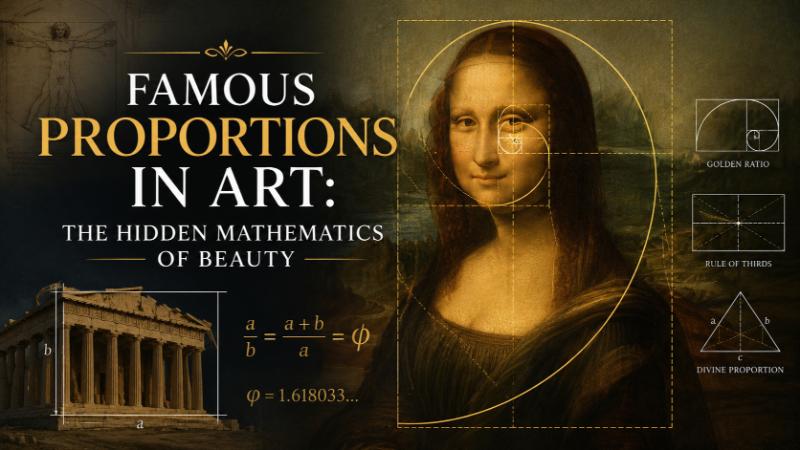
The Golden Ratio is the most famous proportion in art. Its value is approximately 1.618. Artists and mathematicians call it phi (φ). It works like this. Take a line. Divide it into two parts. The ratio of the full line to the longer part must equal the ratio of the longer part to the shorter part. That ratio is the Golden Ratio. It sounds complex. But the result is simple — pure visual harmony.
Where Does It Appear?
The Golden Ratio appears in nature first. It shows up in seashells, sunflowers, and tree branches. Because we see it in nature every day, our brains find it naturally beautiful. Leonardo da Vinci used it in the Mona Lisa. The width and height of her face follow the Golden Ratio. So does the placement of her eyes, nose, and mouth. The Parthenon in Athens also uses this proportion. Its front face fits almost perfectly inside a golden rectangle. Botticelli used it in The Birth of Venus. Salvador Dalí painted The Sacrament of the Last Supper on a canvas whose dimensions match φ exactly. The Golden Ratio creates a composition that feels complete. Nothing needs to be added. Nothing needs to be removed.
2. The Rule of Thirds
What Is It?
The Rule of Thirds is simple and powerful. Divide your canvas into nine equal parts. Use two vertical lines and two horizontal lines. Now place your key subjects along those lines. Or place them at the points where the lines cross. These crossing points are called power points. A subject placed at a power point immediately draws the eye. The composition feels alive.
Where Does It Appear?
John Thomas Smith first wrote about this rule in 1797. He studied landscape paintings and noticed a pattern. Paintings with horizons placed at one-third of the canvas looked far better than centred ones. Jan Vermeer used this rule brilliantly. In Girl with a Pearl Earring, the subject’s eyes sit almost exactly on the upper horizontal third line. Your eye goes straight to her face. The effect is powerful and immediate. Today, this rule is built into every camera app. It is in Adobe Photoshop, Lightroom, and every video editing tool. That alone shows how important it remains.
3. The Vitruvian Canon
What Is It?
Around 25 BC, Roman architect Vitruvius wrote a book called De Architectura. In it, he described the ideal proportions of the human body. He said a perfect human body could fit inside both a circle and a square at the same time. He listed clear measurements. A person’s height equals their arm span. The face is one-tenth of the total body height. The navel sits at the centre of the body when the arms and legs are fully extended.
Where Does It Appear?
Leonardo da Vinci brought this idea to life in his famous drawing Vitruvian Man (c. 1490). It shows a man in two positions — both inscribed inside a circle and a square. This drawing is one of the most recognised images in history. It connects human anatomy with geometry. It says that the human body follows the same laws as the universe. Architects used these proportions to design buildings that feel human and welcoming. Sculptors used them to carve figures that look real and alive.
4. The Fibonacci Spiral
What Is It?
The Fibonacci sequence is a series of numbers. Each number is the sum of the two before it. 1, 1, 2, 3, 5, 8, 13, 21, 34… As the numbers grow larger, the ratio between two consecutive numbers gets closer and closer to 1.618 — the Golden Ratio. When you draw squares using these numbers and connect their corners with a curve, you get the Golden Spiral.
Where Does It Appear?
The spiral appears in the arrangement of seeds in a sunflower. It appears in the curve of a nautilus shell. Artists use it to guide the eye through a composition. Hokusai used it in The Great Wave off Kanagawa (c. 1831). The curl of the great wave follows a Fibonacci spiral. That is why the composition feels both wild and perfectly controlled at the same time.
5. Root Rectangles
What Is It?
Root rectangles use the square roots of numbers to set proportions. The most common is the √2 rectangle. Its sides are in the ratio 1 : 1.414. Cut a √2 rectangle in half and you get two smaller rectangles with the exact same proportions. This makes it perfect for scaling designs up or down without losing shape.
Where Does It Appear?
The standard A4 paper size is based on the √2 rectangle. So are A3, A5, and all other A-series paper sizes. Ancient Greek potters and architects used root rectangles to design their work using only a compass and straightedge.
Comparison Table of Famous Proportions in Art
| Proportion | Value | Origin | Famous Examples | Used In |
|---|---|---|---|---|
| Golden Ratio (φ) | ≈ 1.618 | Ancient Greece | Mona Lisa, Parthenon, Birth of Venus | Painting, Architecture |
| Rule of Thirds | 1:1:1 grid | 18th-century Europe | Girl with a Pearl Earring | Painting, Photography, Film |
| Vitruvian Canon | Body ratios | 1st century BC Rome | Vitruvian Man, classical sculpture | Architecture, Sculpture |
| Fibonacci Spiral | 1,1,2,3,5,8… | Medieval Europe | The Great Wave off Kanagawa | Painting, Illustration |
| √2 Rectangle | 1 : 1.414 | Ancient Greece | A4 paper, Greek ceramics | Design, Craft |
How Artists Use These Proportions Today
These proportions are not just history. Designers use the Golden Ratio to size fonts and layout web pages. Directors use the Rule of Thirds to frame every shot in a film. Architects still reference Vitruvian proportions in modern buildings. Digital tools make it easy. Photoshop and Lightroom have Golden Spiral and Rule of Thirds overlays in their crop tool. Drawing apps let you overlay proportion grids on any canvas. Even artists who have never studied mathematics often use these proportions by instinct. That is because we see them in nature every day. They feel natural because they are natural. Some modern artists deliberately break these proportions. Picasso did. Francis Bacon did. But breaking a rule well requires knowing it first. Every artist who bent the rules had already mastered them.
Conclusion
The greatest art in history is not random. It follows invisible rules. The Golden Ratio, the Rule of Thirds, the Vitruvian Canon, the Fibonacci Spiral — these proportions are the hidden skeleton of visual beauty. Learning them will not make your art mechanical. It will give you a foundation. It will help you understand why some compositions feel right and others do not. Study these proportions. Practice them. Then, when you are ready, make them your own.
FAQs — Famous Proportions in Art
Q1. What is the most famous proportion in art?
The Golden Ratio (φ ≈ 1.618) is the most famous. It appears in the Mona Lisa, the Parthenon, and The Birth of Venus.
Q2. What is the Rule of Thirds?
It divides a canvas into nine equal parts. Key subjects are placed along the dividing lines or at their intersection points for a balanced composition.
Q3. What is the Vitruvian Man?
It is a drawing by Leonardo da Vinci showing a human figure inside a circle and a square. It illustrates the ideal body proportions described by the Roman architect Vitruvius.
Q4. Is the Fibonacci spiral related to the Golden Ratio?
Yes. As the Fibonacci sequence grows, the ratio between consecutive numbers approaches φ ≈ 1.618. The Fibonacci spiral is a visual form of the Golden Ratio.
Q5. Can beginners use these proportions?
Yes. Start with the Rule of Thirds. Divide your canvas into thirds and place subjects along those lines. Most art and photo apps have proportion grids built in.