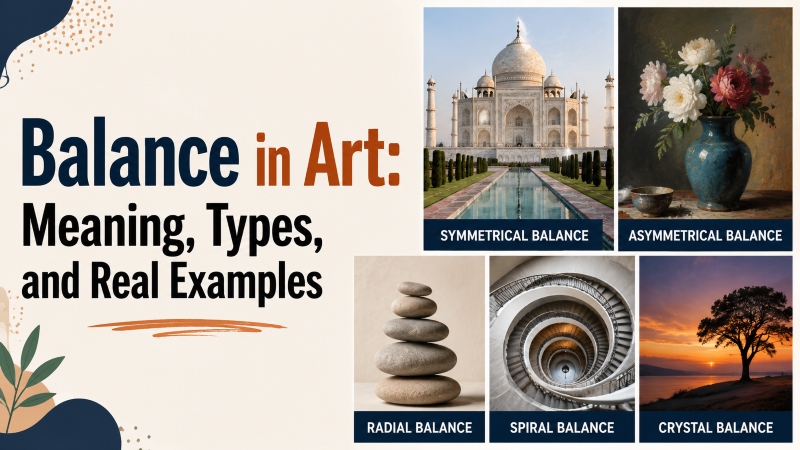
Balance in art is one of the most important principles of design. It refers to the way visual elements are arranged so that no single part of the artwork feels too heavy or overwhelming compared to others. When an artwork is balanced, it feels stable, harmonious, and pleasing to the eye. Artists use balance to guide the viewer’s attention and create a sense of order. Balance is not only about symmetry. It can also be achieved in creative and unexpected ways. In fact, many famous artworks rely on asymmetry or even intentional imbalance to create tension, movement, or emotion. In this article, we will explore the meaning of balance in art, its main types, and real-life examples from famous artworks and design principles. A clear table is also included to help you understand quickly.
What is Balance in Art?
Balance in art refers to the distribution of visual weight within a composition. Visual weight depends on elements such as:
- Color (dark colors feel heavier than light ones)
- Size (larger objects feel heavier)
- Shape (complex shapes feel heavier than simple ones)
- Texture (rough textures feel heavier than smooth ones)
- Position (objects near edges can feel heavier)
When these elements are arranged properly, the artwork feels stable and complete.
Why is Balance Important?
Balance plays a key role in how we experience art. Without it, a composition may feel chaotic or uncomfortable. With proper balance, the viewer can:
- Easily focus on the main subject
- Feel visual harmony
- Understand the message of the artwork
- Stay engaged longer
Artists intentionally use balance to control how viewers move their eyes across the artwork.
Types of Balance in Art
There are three main types of balance used in art:
1. Symmetrical Balance
Symmetrical balance occurs when both sides of an artwork are identical or very similar. If you draw a line down the center, both sides mirror each other.
Characteristics:
- Formal and structured
- Calm and stable feeling
- Often used in architecture and portraits
Example:
A perfect example is Leonardo da Vinci’s The Last Supper. The composition is centered around Jesus, with balanced figures on both sides.
2. Asymmetrical Balance
Asymmetrical balance is when both sides of a composition are different but still feel visually balanced. Instead of identical elements, artists use contrast in size, color, or shape.
Characteristics:
- More dynamic and modern
- Feels natural and interesting
- Requires careful planning
Example:
Vincent van Gogh’s Starry Night uses swirling skies and contrasting shapes to create balance without symmetry.
3. Radial Balance
Radial balance occurs when elements radiate from a central point, like rays from the sun or petals of a flower.
Characteristics:
- Focuses attention at the center
- Creates movement outward
- Often seen in nature and mandalas
Example:
Stained glass windows in Gothic cathedrals often use radial balance, where patterns spread from a central circle.
Examples of Balance in Art
Here is a simple table showing different types of balance with examples:
| Type of Balance | Description | Famous Example | Key Effect on Viewer |
|---|---|---|---|
| Symmetrical | Both sides are identical or mirrored | The Last Supper by Leonardo da Vinci | Feels formal, calm, and stable |
| Asymmetrical | Different elements balanced visually | Starry Night by Vincent van Gogh | Feels dynamic and emotional |
| Radial | Elements radiate from a central point | Cathedral stained glass windows | Feels focused and spiritual |
| Mosaic Balance | Small elements create a unified whole | Islamic geometric patterns | Feels detailed and rhythmic |
| Crystallographic | Repeated elements with no clear focus | Jackson Pollock abstract paintings | Feels chaotic but unified |
Balance in Famous Artworks
1. Leonardo da Vinci – The Last Supper
This painting is one of the best examples of symmetrical balance. Jesus is placed at the center, and the apostles are arranged evenly on both sides. The architecture also supports this symmetry, creating a strong sense of order and importance.
2. Vincent van Gogh – Starry Night
This artwork uses asymmetrical balance. The sky is filled with movement and energy, while the village below is calm and stable. Even though the elements are not mirrored, the painting feels balanced because the visual weight is distributed carefully.
3. Claude Monet – Water Lilies
Monet’s paintings often use asymmetrical and near-radial balance. The reflection of water, floating lilies, and soft brush strokes create harmony without strict structure.
4. Islamic Geometric Art
Islamic art is a great example of mosaic balance. Repeated geometric patterns create unity and rhythm across surfaces like walls, tiles, and domes. Even though there is no single focal point, the design feels complete.
5. Jackson Pollock – Abstract Expressionism
Pollock’s drip paintings use crystallographic balance. Paint is scattered across the canvas, but the overall composition still feels unified. There is no central focus, yet the eye moves naturally across the surface.
How Artists Create Balance
Artists use several techniques to achieve balance:
1. Color Balance
Dark colors are visually heavier than light ones. A small dark object can balance a large light object.
2. Size and Scale
Large objects balance smaller ones depending on placement.
3. Positioning
Objects placed farther from the center feel heavier and need balancing elements.
4. Texture and Detail
Highly detailed areas attract more attention and require balancing with simpler areas.
5. Contrast
Strong contrast between light and dark, or smooth and rough, helps distribute visual weight.
Balance in Modern Design
Balance is not only important in traditional art. It is also widely used in:
- Graphic design
- Web design
- Advertising
- Photography
- Interior design
For example, websites often use asymmetrical balance to make layouts more engaging while still keeping content easy to read.
Conclusion
Balance in art is a powerful principle that helps create harmony, structure, and visual interest. Whether symmetrical, asymmetrical, or radial, balance ensures that an artwork feels complete and visually satisfying. Famous artists like Leonardo da Vinci, Vincent van Gogh, and Claude Monet used balance in very different ways, showing that there is no single correct method. Instead, balance is a flexible tool that artists use to express ideas, emotions, and creativity. Understanding balance helps us not only appreciate art better but also improve our own creative work in design, photography, and visual communication.