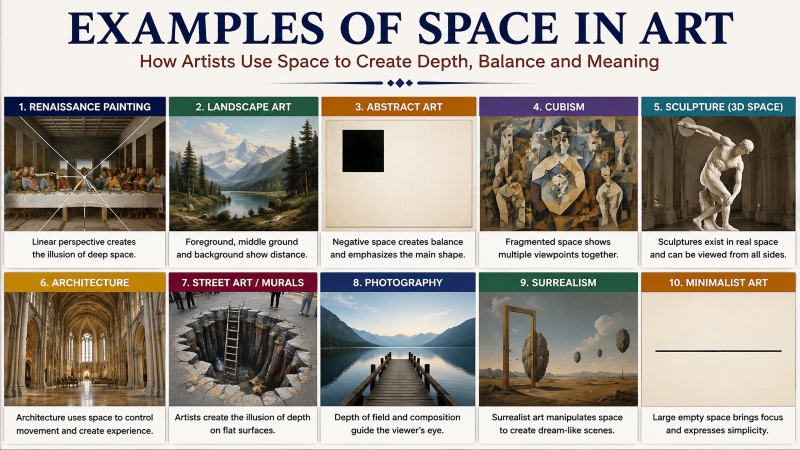
Space is one of the most important elements of art. It refers to the area within, around, and between objects in an artwork. Artists use space to create depth, balance, perspective, and emotion. Without space, artworks would look flat, confusing, and lifeless. In this article, we will explore examples of space in art, how artists use it, and why it is essential for visual storytelling.
What is Space in Art?
In art, space is the illusion or reality of depth and distance between objects. It can be:
- Positive space: The main subject or objects in the artwork
- Negative space: The empty or open areas around the subject
Artists carefully balance both types of space to guide the viewer’s eye and create meaning.
Space can also be:
- 2D space (flat drawings, paintings)
- 3D space (sculptures, installations, architecture)
Why Space is Important in Art
Space is not just empty background—it is an active design element. It helps artists:
- Create depth and perspective
- Focus attention on the main subject
- Build mood and emotion
- Organize composition
- Make artwork realistic or abstract
Without proper use of space, even a well-drawn subject can feel flat or confusing.
Types of Space in Art
Before looking at examples, it’s important to understand the main types of space:
1. Positive Space
The filled areas—objects, figures, or shapes.
2. Negative Space
The empty areas around and between subjects.
3. Deep Space
Creates the illusion of distance (foreground, middle ground, background).
4. Shallow Space
Minimal depth, often used in abstract or modern art.
Examples of Space in Art
Now let’s explore real and conceptual examples of how space is used in different art forms.
1. Renaissance Paintings (Linear Perspective)
Renaissance artists like Leonardo da Vinci used linear perspective to create realistic space. Objects become smaller as they move further away, creating deep space.
Example:
- “The Last Supper” shows strong perspective lines leading toward the center.
2. Landscape Paintings
Landscape artists use foreground, middle ground, and background to show distance.
Example:
- A painting of mountains, trees, and sky shows deep spatial layering.
3. Abstract Art (Negative Space Focus)
Abstract artists often use large empty spaces to create balance and emotion.
Example:
- Minimalist paintings with a single shape surrounded by empty canvas.
4. Cubism (Fragmented Space)
Artists like Pablo Picasso broke space into geometric shapes, showing multiple perspectives at once.
Example:
- “Les Demoiselles d’Avignon” distorts space intentionally.
5. Sculpture Art (Real 3D Space)
Sculptures exist in real space and can be viewed from all angles.
Example:
- Statues in museums interact with physical space around them.
6. Architecture
Buildings are designed using space to control movement and experience.
Example:
- Large open halls create a feeling of freedom and scale.
7. Street Art and Murals
Artists use walls and surrounding space to create illusions.
Example:
- 3D street paintings that look like holes or stairs in the ground.
8. Photography
Photographers use framing, depth of field, and composition to manage space.
Example:
- A blurred background with a sharp subject in the front.
9. Surrealism
Surrealist artists manipulate space to create dream-like worlds.
Example:
- Floating objects in impossible environments.
10. Minimalist Art
Minimalism uses large negative space to emphasize simplicity.
Example:
- A single black line on a white canvas.
Examples of Space in Art
| Art Style / Form | Type of Space Used | How It Works | Example |
|---|---|---|---|
| Renaissance Painting | Deep space, perspective | Objects shrink with distance | The Last Supper |
| Landscape Art | Foreground & background | Layers of depth | Mountain scenery paintings |
| Abstract Art | Negative space | Empty areas create balance | Minimalist canvas art |
| Cubism | Fragmented space | Multiple viewpoints combined | Les Demoiselles d’Avignon |
| Sculpture | Real 3D space | Physical form in environment | Marble statues |
| Architecture | Functional space | Open/closed spatial design | Cathedrals, modern buildings |
| Street Art | Illusion of depth | 3D painted effects | Pavement illusion art |
| Photography | Compositional space | Focus vs blur separation | Portrait photography |
| Surrealism | Dream-like space | Impossible spatial scenes | Floating objects art |
| Minimalism | Empty negative space | Simplicity and focus | Single shape artworks |
How Artists Use Space to Create Meaning
Space is not random. Artists use it to communicate ideas:
Emotional Impact
- Large empty space can feel lonely or peaceful
- Crowded space can feel intense or chaotic
Focus and Attention
- The subject is placed in a way that guides the viewer’s eye
Symbolism
- Empty space can represent silence, emptiness, or freedom
Balance
- Proper spacing makes artwork visually stable
Techniques Artists Use to Control Space
Artists use different techniques to manage space effectively:
- Overlapping: Objects placed over others to show depth
- Size variation: Smaller objects appear farther away
- Color and contrast: Fading colors create distance
- Perspective lines: Guide the eye into depth
- Foreground framing: Adds focus and structure
Conclusion
Space in art is much more than empty background—it is a powerful tool that shapes how we see and feel an artwork. From Renaissance perspective to modern minimalism, artists have always used space to create depth, meaning, and emotion. Understanding examples of space in art helps us appreciate artworks on a deeper level and improves our own creative skills. Whether it is a painting, sculpture, photograph, or building, space is always working silently in the background to bring art to life.