Introduction
Texture in art is one of the most important elements that artists use to bring life, depth, and realism to their work. It refers to the surface quality of an artwork—how it looks or feels. Texture can make a painting feel rough, smooth, soft, hard, glossy, or matte. Even when an artwork is completely flat, artists can create the illusion of texture through clever techniques. Understanding examples of texture in art helps students, artists, and art lovers appreciate how visual and physical effects influence emotion and meaning in artwork. From classical oil paintings to modern digital designs, texture plays a key role in shaping artistic expression. In this detailed guide, we will explore the meaning of texture, its types, techniques used by artists, real-world examples, and a comprehensive table for better understanding.
What is Texture in Art?
Texture in art refers to the perceived surface quality of an artwork. It can be experienced in two main ways:
- Physically (Tactile Texture): You can actually feel it with your hands.
- Visually (Implied Texture): It looks like it has texture but is actually flat.
Artists use texture to create depth, realism, contrast, and emotional impact. Without texture, artworks may appear dull or lifeless.
For example, a painting of a tree may show rough bark, soft leaves, and smooth sky—all created using different textures.
Types of Texture in Art
1. Actual (Tactile) Texture
Actual texture is the real physical feel of an artwork. It exists in three-dimensional form or thick material application.
Examples:
- Sculptures made of marble, wood, or bronze
- Thick oil paint applied with a palette knife (impasto)
- Mixed media art with fabric, sand, or paper
This type of texture can be touched and physically experienced.
2. Visual (Implied) Texture
Visual texture is not physically present but is created using artistic techniques that simulate surface quality.
Examples:
- A painting of soft fur that looks real but is flat
- Pencil shading that creates the illusion of smooth skin
- Drawings of rough rocks or wooden surfaces
This type of texture depends on how the eye interprets the artwork.
3. Abstract Texture
Abstract texture is created using patterns, shapes, and repeated marks that do not represent real-life surfaces.
Examples:
- Abstract expressionist paintings
- Geometric art designs
- Digital pattern-based artwork
It is often used to create mood and visual interest rather than realism.
4. Invented Texture
Invented texture refers to textures that do not exist in real life but are created for artistic imagination.
Examples:
- Fantasy landscapes in digital art
- Surreal paintings
- Sci-fi themed illustrations
This type of texture is common in modern digital and conceptual art.
Techniques Used to Create Texture in Art
Artists use several techniques to create both real and visual textures:
- Impasto: Thick layers of paint applied for a raised surface effect
- Dry Brush: Using a brush with little paint for rough texture
- Stippling: Creating texture using small dots
- Hatching & Cross-Hatching: Lines used for shading and texture
- Collage: Adding materials like paper, fabric, or photos
- Sgraffito: Scratching into paint or clay for patterns
- Sponging: Using a sponge to create uneven textures
These techniques allow artists to control how viewers perceive their work.
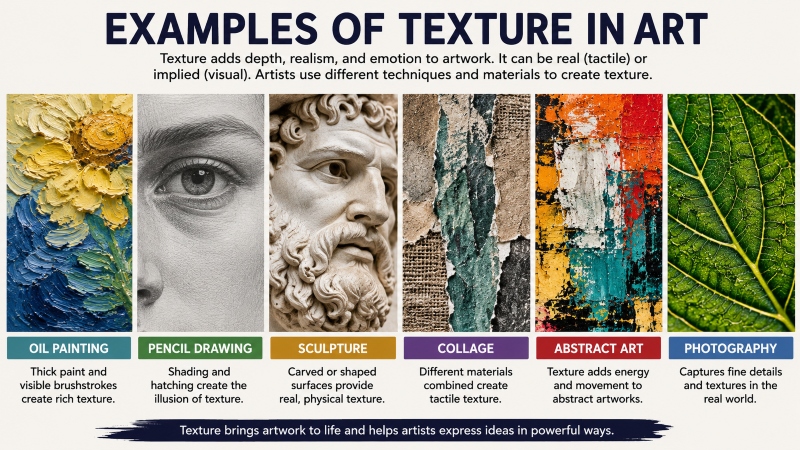
Examples of Texture in Art
| Art Form | Example | Type of Texture | How It is Created | Effect on Viewer |
|---|---|---|---|---|
| Painting | Van Gogh’s Starry Night | Actual & Visual | Thick brushstrokes (impasto) | Creates movement and emotion |
| Sculpture | Michelangelo’s David | Actual | Carved marble | Realistic human skin feel |
| Drawing | Pencil portrait shading | Visual | Gradients and hatching | Soft realistic skin effect |
| Digital Art | 3D metal or fabric rendering | Visual | Software-generated textures | Hyper-realistic appearance |
| Collage Art | Mixed paper and fabric art | Actual | Materials glued on canvas | Physical depth and complexity |
| Oil Painting | Thick landscape paintings | Actual | Layered oil paint | Rich and expressive surface |
| Abstract Art | Jackson Pollock drip painting | Actual & Visual | Dripping and splashing paint | Energetic and chaotic feel |
| Photography | Macro leaf photography | Visual | Camera focus and lighting | Realistic surface detail |
| Printmaking | Etching on metal plates | Visual | Carving lines into surface | Fine detailed texture |
| Mixed Media | Fabric + paint + sand artwork | Actual | Combining materials | Strong tactile effect |
Famous Artists Known for Texture
Vincent van Gogh
Van Gogh is famous for using thick, emotional brushstrokes. His paintings show strong texture that expresses movement and emotion.
Jackson Pollock
Pollock used drip painting techniques to build layered textures. His work focuses on movement and energy rather than objects.
Michelangelo
His sculptures show incredibly smooth and realistic textures, especially in human anatomy carved from marble.
Claude Monet
Monet used soft brushwork to create natural textures in water, sky, and light effects.
Importance of Texture in Art
Texture plays a major role in making art meaningful and engaging:
- Adds depth and dimension to flat surfaces
- Creates realism or abstraction depending on style
- Enhances emotional expression
- Helps guide the viewer’s attention
- Makes artwork more visually interesting
Without texture, even a well-drawn artwork can feel incomplete or lifeless.
How Texture Affects Emotion in Art
Texture is not only visual—it also affects how we feel:
- Smooth textures → Calm, peaceful emotions
- Rough textures → Energy, tension, or chaos
- Soft textures → Comfort and warmth
- Sharp textures → Drama or intensity
Artists use these emotional effects to communicate meaning without words.
Modern Use of Texture in Digital Art
In today’s world, texture is widely used in digital design:
- Video games use realistic textures for environments
- Movies use CGI textures for realism
- Graphic designers use patterns for branding
- UI/UX design uses subtle textures for depth
Digital tools like Photoshop and Blender allow artists to create highly detailed textures that mimic real life.
Conclusion
Texture in art is a powerful element that brings creativity, depth, and realism into artwork. Whether it is physical texture you can touch or visual texture you can only see, it plays a key role in shaping how we experience art. From classical sculptures to modern digital creations, examples of texture in art show how artists use surface quality to express emotion, tell stories, and create visual impact. Understanding texture helps us appreciate art more deeply and recognize the skill behind every brushstroke, carving, or digital design.