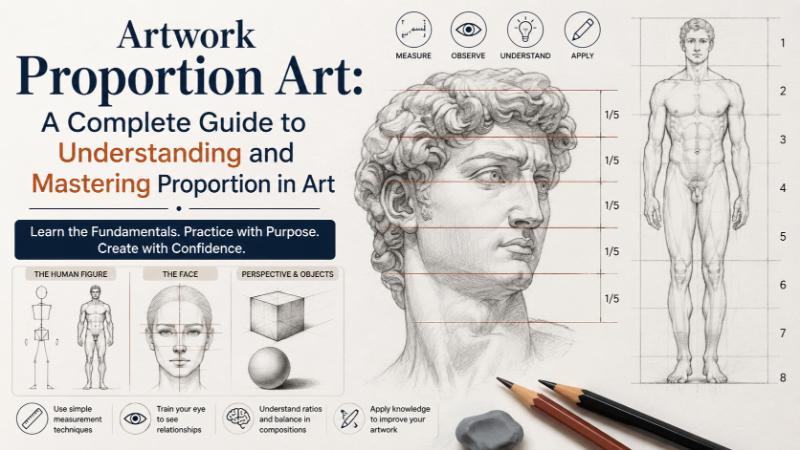
Whether you are a beginner picking up a pencil for the first time or an experienced artist refining your craft, proportion is one concept you simply cannot ignore. It is the invisible force behind every great painting, sculpture, and drawing. It is what makes the human figure look real, what makes a landscape feel balanced, and what makes a composition draw the eye in all the right directions. In this complete guide, we will explore everything you need to know about artwork proportion art — what it means, why it matters, the types that exist, and how to master it in your own creative work.
What Is Proportion in Art?
Proportion is an important principle of art and design. It is defined as the ratio of the dimensions of one element to another within a composition, or the relative size of the parts of a whole. In simpler terms, proportion is about how different parts of an artwork relate to each other in terms of size. Proportion does not refer to overall size, but rather the relationship of the sizes of two or more subjects or elements. In art, the size of an element is referred to as scale. Proportion is a principle of art that is relevant to any material, medium, or style. It is just as important to those creating hyper-realistic artwork as it is to those seeking to create abstract compositions. Understanding proportion is the foundation of creating artwork that feels visually balanced, emotionally powerful, and technically sound.
Proportion vs. Scale: What Is the Difference?
Many artists confuse proportion with scale. While the two concepts are related, they are not the same thing. Proportion refers to the size relationship between parts within a single object or composition. Scale relates to the size of an entire object in comparison to another object or its environment. A simple example: if you draw a human figure where the head is the correct size relative to the body, that is good proportion. But if you draw that same figure next to a mountain that looks tiny, that is a problem with scale. In experiencing the scale of an artwork, we tend to compare its size to the size of our own bodies.
Types of Proportion in Art
Understanding the different types of proportion helps artists make intentional decisions about their compositions.
| Type | Description | Famous Example |
|---|---|---|
| Standard Proportion | Realistic size relationships matching real life | Da Vinci’s Vitruvian Man |
| Altered Proportion | Distorted sizes for artistic effect | Picasso’s Les Demoiselles d’Avignon |
| Hierarchical Proportion | Important figures made larger to show status | Byzantine mosaics, Ancient Egyptian art |
| Mathematical Proportion | Based on the Golden Ratio for visual harmony | The Parthenon, Renaissance paintings |
| Out-of-Proportion | Exaggerated for dramatic or surreal impact | Caricatures, Surrealist art |
Standard proportion refers to proportions that are created correctly when compared to proportions that exist within reality. Standard proportion is important for artists looking to create realistic compositions. Altered proportion artwork refers to the manipulation of proportion to achieve a specific visual effect. Altered proportion is often used intentionally, typically to create more stylized and expressive compositions. Hierarchical proportion is the intentional use of proportion to depict a hierarchy within a composition. Hierarchical proportion denotes levels of power, status, or importance based on the proportions the artist chooses.
The Golden Ratio: The Mathematical Secret Behind Beautiful Art
One of the most fascinating aspects of proportion in art is the Golden Ratio. For a millennia, artists have sought the most aesthetically pleasing way to arrange visual components in a composition. One popular concept was discovered by the ancient Greek mathematician Euclid. He called this ratio the Golden Mean, with the ratio expressed in numbers as 1.6180:1. The Golden Mean helps designers create layouts, logos, and compositions that feel naturally balanced and visually appealing. It has been used in famous artworks, architecture, and branding to guide attention and enhance aesthetic appeal. This ratio appears everywhere in nature — in the spiral of a seashell, the arrangement of sunflower seeds, and the branching of trees. Artists who understand the Golden Ratio can use it to create compositions that feel instinctively satisfying to the human eye, even if the viewer cannot explain exactly why.
Why Is Proportion Important in Art?
Proportion does far more than simply make things look “correct.” It plays a deep role in how viewers feel when they look at an artwork. Proportion is a fundamental principle of art that influences the balance and harmony of a composition. It impacts the viewer’s perception of the artwork, guiding their eye across the piece. Proportion in art can evoke emotions or convey messages based on how elements are sized and positioned. Well-proportioned artworks frequently foster positive feelings and emotions, providing coziness, stability, and order. Conversely, purposefully off-balance proportions can evoke intrigue, suspense, or thrill. When an artist understands proportion deeply, they gain the power to control how a viewer feels — whether calm, unsettled, inspired, or awestruck.
Proportion in Drawing the Human Figure
Proportion becomes especially critical when drawing people. The human body follows a set of natural ratios that viewers instinctively recognize. When these ratios are off, even slightly, the figure looks wrong — even if the viewer cannot pinpoint why. There are rules of proportion for drawing the human figure, especially the human head and face. Once you get a handle on average human proportions, you may tweak them to make your drawing more dynamic. In the first century, a Roman architect named Vitruvius studied proportion. He believed that the human body was, aesthetically, the best example of proportion. He applied human proportions to his own architectural designs. Building on the concept of a universally aesthetic proportion, Leonardo Da Vinci attempted to illustrate the ideal human proportions laid out by Vitruvius centuries before, creating the famous “Vitruvian Man.”
Famous Examples of Proportion in Art History
Some of the greatest masterpieces in art history are celebrated precisely because of how masterfully their creators used proportion.
Leonardo da Vinci — The Vitruvian Man: The ultimate study of human proportion, combining art and science in one drawing.
Michelangelo — David: The proportions within the body of David are based on an ancient Greek mathematical system meant to define perfection in the human body.
Pablo Picasso — Les Demoiselles d’Avignon: A brilliant example of altered proportion, where deliberately distorted figures create the revolutionary Cubist style.
El Greco — Religious Paintings: El Greco chose to exaggerate the human figure in nearly all of his paintings. His method of exaggeration was elongation. El Greco felt that by stretching the human form, he was directing his audience to look upward and think about God.
How to Achieve Correct Proportion in Your Artwork
Mastering proportion takes practice, but there are proven techniques that every artist can use.
Sighting Technique: Artists measure the size of elements using a measurement tool like a pencil. To sight and measure a reference, sit in one fixed spot, extend your arm with your pencil, and measure it against your view of your reference. Then mark on your pencil the placement of the main features of the reference and transfer these measurements to the drawing.
Grid Drawing: Divide your reference image and your canvas into equal grids. This allows you to focus on one section at a time and get the proportions of each part right before putting it all together.
Comparative Drawing: Use one object as a reference point to measure all other objects against. This trains your eye to see size relationships more accurately over time.
Proportional Dividers: Employing grids, proportional dividers, and sight-sizing techniques aids in accurately capturing proportions. These tools provide reference points, making it easier to replicate the correct size relationships in artwork.
Proportion and Balance: How They Work Together
Proportion and balance are deeply connected. Balance in art is about distributing elements to create a sense of stability. Proportion is crucial in achieving balance by ensuring that elements are sized and placed harmoniously. A well-proportioned artwork naturally achieves balance, as the elements are scaled and positioned in a way that neither overwhelms nor underwhelms the viewer. When proportion is off, balance suffers. When proportion is handled well, the entire composition feels unified and visually satisfying — even if the viewer never consciously notices why.
Tips for Beginners: Building Your Sense of Proportion
Getting proportion right is a skill that develops with practice. Here are practical tips to get started:
Draw from life regularly. Nothing builds proportion awareness faster than drawing real objects and people in front of you. Your eye learns the correct relationships simply through repeated observation.
Study anatomy. For figure drawing in particular, understanding basic human anatomy gives you a mental map of correct proportions before you even put pencil to paper.
Practice still life drawing. Drawing still life arrangements allows artists to study the size relationships between objects, improving the understanding of proportion and spatial relationships within a composition.
Be patient with yourself. Proportions are hard to teach because of how much guesswork and rules you need to create as the artist. There is no surefire formula — it is something you just slowly get better at with practice.
Final Thoughts
Proportion is not just a technical rule — it is a creative tool. Whether you use it to achieve photographic realism, to distort reality for emotional effect, or to create a perfectly balanced composition that draws the eye, proportion is at the heart of every artistic decision you make. Any artist who wants to produce unified and captivating visual art must grasp proportion, whether it is used for artistic expression or realism. From the ancient Greeks to Leonardo da Vinci, Proportion in Art History from Picasso to modern digital artists, proportion has always been and will always be one of the most powerful principles in all of art. Start observing it, start practicing it, and watch how it transforms your artwork from good to truly great.
Frequently Asked Questions (FAQs)
Q1. What is proportion in artwork?
Proportion is the size relationship between different elements within an artwork that creates balance and harmony.
Q2. What is the difference between proportion and scale?
Proportion is the size of parts within one object, while scale is the size of one whole object compared to another.
Q3. What are the main types of proportion in art?
The four main types are Standard, Altered, Hierarchical, and Mathematical proportion.
Q4. What is the Golden Ratio in art?
The Golden Ratio is a mathematical ratio of 1.6180:1 used by artists to create naturally balanced and visually pleasing compositions.
Q5. How can beginners improve proportion in drawings?
Beginners can improve by drawing from life, using grid drawing, and practicing the sighting technique with a pencil.