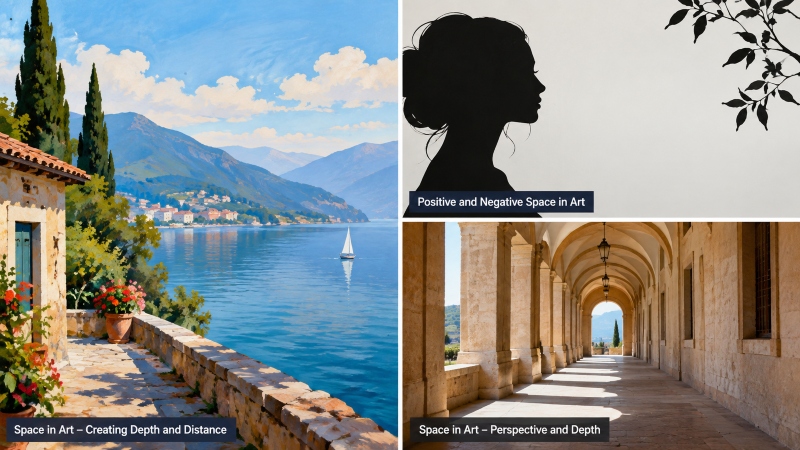
Space in art is one of the fundamental elements that artists use to organize objects, create depth, and guide the viewer’s attention. Although space may seem empty at first, it plays an important role in every composition. The distance between objects, the area around a subject, and the space inside or outside forms can all affect how an artwork looks and feels.
Artists use space in different ways depending on their subject, style, and purpose. A realistic painter may use space to create the illusion of a three-dimensional environment. On the other hand, a modern or abstract artist may use empty areas to create balance, tension, or visual interest. Understanding space helps artists create stronger compositions. It also helps viewers understand the relationship between objects and the environment surrounding them.
What Is Space in Art?
Space in art refers to the area around, between, within, or occupied by objects in an artwork. It can be an actual physical area, such as the space surrounding a sculpture, or an illusion created on a flat surface, such as a painting or drawing. In two-dimensional art, artists often create the impression of space through size, overlap, perspective, placement, color, and value. For example, an object that appears smaller and farther away can create a sense of distance.
In three-dimensional art, space is more direct because sculptures and installations occupy physical areas. Viewers can move around them and experience the relationship between the artwork and its surrounding environment. Therefore, space in art is not simply an empty area. It is an active part of the composition that can influence depth, movement, balance, and meaning.
Why Is Space Important in Art?
Space is important because it helps artists organize their compositions. Without thoughtful use of space, an artwork can feel crowded, confusing, or disconnected. For example, if several objects are placed very close together, the composition may feel busy or intense. In contrast, leaving more empty space around an object can make it appear important or isolated.
Space can also create depth. Artists can make a flat surface appear three-dimensional by showing relationships between objects at different distances. Moreover, space affects the viewer’s eye movement. Carefully arranged objects and empty areas can guide attention from one part of the artwork to another. For this reason, learning how to use space is essential for painting, drawing, photography, graphic design, sculpture, architecture, and digital art.
Types of Space in Art
Artists generally work with several types of space. Each type serves a different purpose and can change the way a composition is experienced.
| Type of Space | Meaning | Example |
|---|---|---|
| Positive Space | Area occupied by the main subject or objects | A person in a portrait |
| Negative Space | Empty area surrounding or between subjects | The background around a figure |
| Open Space | An area that appears to extend beyond the artwork | A landscape showing a wide sky |
| Closed Space | A contained area with clear boundaries | Objects arranged inside a room |
| Deep Space | A composition that creates a strong sense of distance | A road disappearing toward the horizon |
| Shallow Space | Objects appear close to the surface | A flat decorative composition |
| Two-Dimensional Space | Space represented on a flat surface | A drawing or painting |
| Three-Dimensional Space | Physical space occupied by forms | A sculpture or installation |
Understanding these categories allows artists to make deliberate decisions about how they want viewers to experience their work.
Positive Space
Positive space is the part of an artwork occupied by recognizable objects, subjects, shapes, or forms. For example, in a portrait, the person’s face and body occupy positive space. In a landscape, trees, buildings, mountains, and other objects can occupy positive space.
Positive space usually attracts attention because it contains the main visual subjects. However, the amount and arrangement of positive space can greatly affect the composition. Artists can use several positive shapes together to create rhythm, movement, or visual hierarchy.
Negative Space
Negative space is the empty area surrounding or between objects. It is sometimes called the background, although negative space can occur anywhere within a composition. Negative space is especially important because it gives positive forms room to exist. Without enough space around objects, an artwork may feel crowded.
For example, a simple logo may contain a large amount of negative space. This empty area can make the main symbol easier to recognize. Artists can also use negative space creatively. In some artworks, the empty areas form recognizable shapes of their own. Therefore, negative space should not be considered unimportant. In many compositions, it is just as important as the objects themselves.
Space and Depth in Art
One of the most important functions of space in art is creating the illusion of depth. A flat painting has only height and width, yet artists can make viewers feel that they are looking into a deep environment. They achieve this through several techniques.
Overlapping
When one object overlaps another, the viewer usually understands that the overlapping object is closer.
Size
Objects that appear smaller are often interpreted as being farther away. Larger objects usually appear closer.
Placement
Objects placed higher in the picture plane can sometimes appear farther away, especially in landscapes.
Perspective
Linear perspective uses lines and diminishing scale to create the appearance of distance. Roads, buildings, and railway tracks can appear to move toward a distant point.
Atmospheric Perspective
Artists can also use color and value to suggest distance. Distant objects may appear lighter, less detailed, or less distinct than nearby objects. Together, these techniques allow artists to transform a flat surface into an environment that appears to have depth.
Open and Closed Space
Another useful distinction is between open and closed space. Open space gives the impression that the environment continues beyond the boundaries of the artwork. A landscape with a wide horizon is a good example. The viewer may feel that the scene extends beyond what is shown.
Closed space, however, feels more contained. A painting of objects arranged inside a small room can create a sense of enclosure. Artists can use these approaches to influence mood. Open space may suggest freedom, distance, or possibility, while closed space can create intimacy, limitation, or concentration.
Space in Two-Dimensional Art
Paintings, drawings, illustrations, photographs, and many digital artworks use a flat surface. However, artists can still create convincing spatial relationships. They may use perspective, overlapping, scale, placement, shading, and color to create depth.
At the same time, an artist does not always need to create realistic depth. Some artworks intentionally flatten space. Decorative art, graphic design, and certain forms of modern art may place shapes close to the surface. This shows that space in art is not limited to realistic representation. Artists can either create an illusion of depth or intentionally emphasize the flat surface.
Space in Three-Dimensional Art
Sculpture provides a different experience of space because the artwork exists in physical space. A viewer can walk around a sculpture and see it from different angles. The space surrounding the sculpture becomes part of the visual experience.
Installations can take this idea even further. An artist may design an entire room or environment so that viewers physically enter the artwork. Architecture also demonstrates the importance of three-dimensional space. Rooms, doors, windows, corridors, and open areas are organized to control movement and human experience.
Space and Composition
Space plays a major role in composition because it affects how visual elements relate to one another. A well-organized composition usually contains a thoughtful relationship between occupied and unoccupied areas. Artists may place a subject in the center for emphasis or move it to one side to create a more dynamic arrangement.
For example, placing a person on one side of a photograph while leaving open space in front of their gaze can create a sense of direction. The empty area gives the viewer a visual path to follow. This relationship between objects and empty areas can also support other principles of art, such as balance, unity, contrast, and emphasis.
Space and Balance
Space can strongly influence visual balance. If one side of an artwork contains a large object, the artist may leave more open space on the opposite side. Alternatively, several smaller objects can balance one large form. Symmetrical compositions often distribute space evenly. Asymmetrical compositions may use different sizes and positions to create a more dynamic balance. Thus, artists do not simply decide where to place objects. They also decide how much space each object should have.
Space and Emotion
The use of space can influence the emotional quality of an artwork. A large amount of empty space may create feelings of calmness, loneliness, freedom, or isolation. A crowded composition may feel energetic, chaotic, busy, or intense. However, the emotional effect depends on the subject and context. The same amount of empty space can communicate different ideas in different artworks. Therefore, artists can use space as a storytelling tool. They can make a subject appear powerful by surrounding it with open space, or make it appear trapped by placing it within a restricted environment.
How to Use Space Effectively
Artists can improve their use of space by following a few practical principles:
- Plan the composition before starting. Consider where the main objects and empty areas will appear.
- Use negative space intentionally. Do not treat empty areas as accidental leftovers.
- Create depth when necessary. Use size, overlap, perspective, and placement to show distance.
- Consider balance. Make sure the distribution of objects and empty areas supports the composition.
- Use space to guide attention. Place important subjects where they can receive visual emphasis.
- Experiment with open and closed compositions. Different spatial arrangements can produce different moods.
- Think about the viewer. Consider how the viewer’s eye will move through the artwork.
These methods can help beginners develop stronger compositions while giving experienced artists more control over their visual language.
Space in Different Art Forms
The concept of space appears in almost every creative field and plays a different role in each one. Painting uses spatial relationships to create depth, distance, and a sense of environment. Through perspective, shading, and proportion, drawing can make flat forms appear three-dimensional. Photography uses framing, composition, and negative space to guide the viewer’s attention toward important subjects. In graphic design, carefully planned empty space improves readability, organization, and visual clarity. Sculpture, by contrast, exists within physical space, allowing viewers to experience the artwork from different angles.
The arrangement of rooms, structures, and open areas makes architecture another important example of spatial design. Meanwhile, digital art combines traditional spatial techniques with digital tools to create realistic, abstract, or imaginative environments. As a result, understanding space is valuable for anyone studying visual art, design, photography, architecture, or other creative disciplines.
Conclusion
Space in art is much more than an empty area. It is a powerful element that helps artists organize compositions, create depth, establish balance, guide attention, and communicate emotion. Positive space contains the main subjects, while negative space surrounds and separates them. Artists can also use perspective, size, overlap, placement, and color to create the illusion of distance.
Most importantly, effective use of space gives every element room to function within the composition. Whether an artist creates a realistic landscape, a simple graphic design, an abstract painting, or a three-dimensional sculpture, space remains an essential part of the visual experience. By studying and practicing the use of space, artists can create compositions that are clearer, more balanced, more engaging, and more meaningful.